Building Your Own Music Library
(Note: This is second half to what was originally a larger, single post that got way too long, so I split it in half. The first half can be found here.)
Alright, we’re talking music. Specifically digital music. If you’re also the kind of person who’s into buying vinyl like I am, that’s awesome, but there’s not really much for me to say about that here.
Actually, no, I do have one thing to say about vinyl - stop fucking using those cheap Crosley suitcase turntables!! They’re shit, they sound like shit, and there’s no point to spending a bunch of money on vinyl if you’re just gonna ruin the entire experience at the end. There’s a reason why you can pick one up from the local Pottery Barn or Walmart; They’re decorative furniture meant to scam hipsters and posers who only listen to vinyl because they think it makes them more interesting. And they’ve overpriced as shit anyway, so you might as well just get a real turntable with that money instead. Have some self-respect.
Ahem. Anyway.
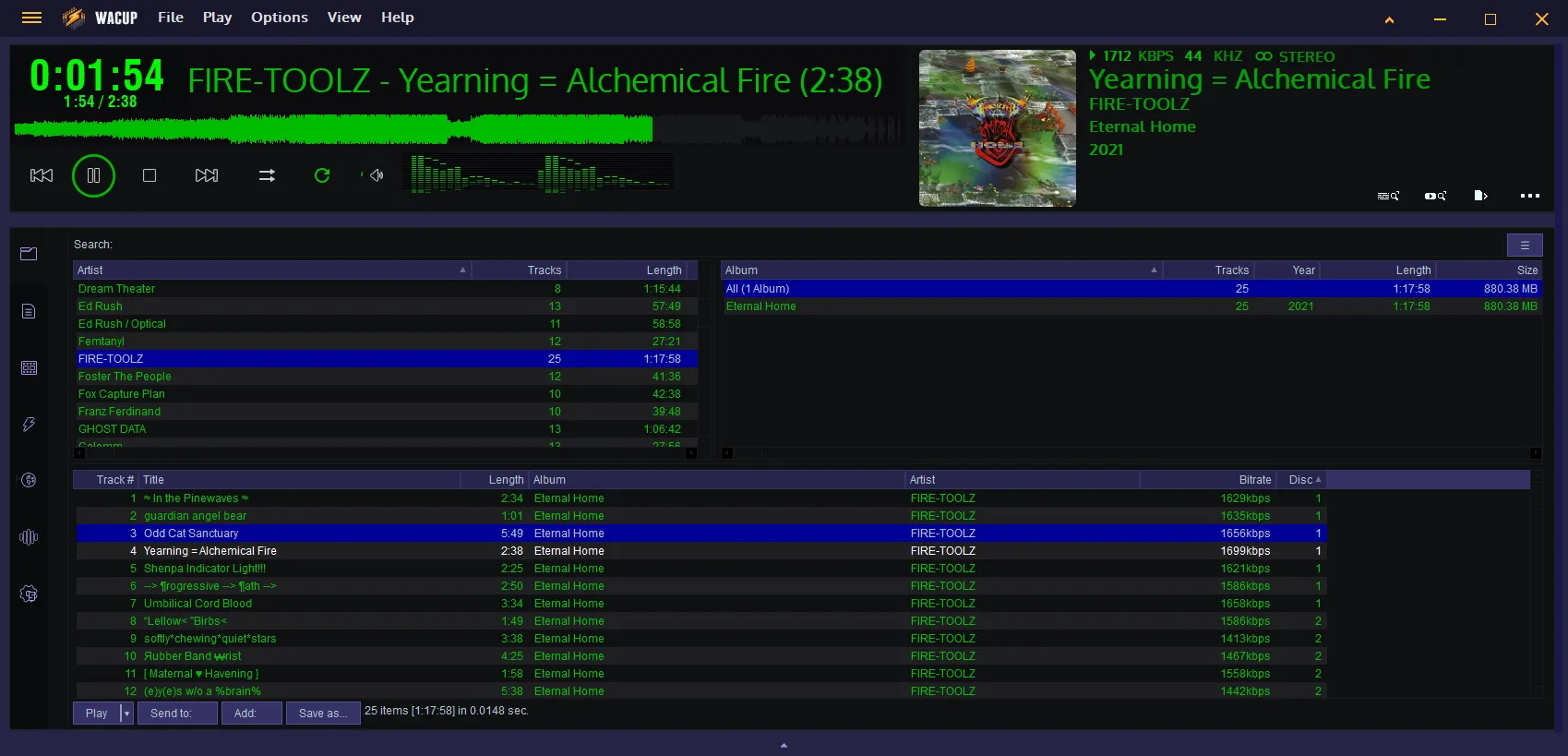
1] Install a proper media player. Don’t be using the junk that comes default on your computer or phone.
If you’re old or terminally online then you probably remember Winamp. There was a time where it was the Gold Standard for MP3 players. I’m sorry to have to tell you that it sucks now. The new parent company doesn’t seem to know what they’re doing with it or what they even want it to be.
I use WACUP instead. It’s a modern replacement/upgrade/successor to Winamp v5.666, which was the last “real” Winamp release. The project is still a work in progress but otherwise very good. Currently it relies on an existing installation of Winamp to function (which it will handle for you) but my understanding is that they’re aiming to remove that dependency eventually.
For mobile/android, I use Poweramp. Yes, it costs money, but if you really can’t spare a few bucks for it then you’ve got better things to worry about. There’s a free trial if you want to try that first.
Sorry Mac and iPhone users, I’ve got no suggestions for you. I’m sure there are plenty of other acceptable media players out there, but you’re on your own here. Make better life choices in the future.
2] Make sure you’re using good quality music files. Toss out all of those Limewire MP3s and get some hi-res audio files in either FLAC or WAV format.
Okay wait, we need to talk about audio quality.
Here’s the thing: “Hi-Res” audio is an unnecessary luxury you’re only going to benefit from if you’re a huge music nerd with the right hardware (we’ll get to some of that later) and honestly, it’s not something I can recommend to the average person. It’s more expensive, takes up way more disk space, and if you’re just listening to music on your earbuds or - gods forbid - a pair of Beats or Skullcandy headphones, then you’re literally just wasting money buying anything higher than 44k/16-bit (aka “CD-quality”) music. For reference, Franz Ferdinand’s Always Ascending at 96k/24-bit quality in FLAC format takes up ~860 MB for only 40 minutes of music. The original iPod would only be able to store 5 copies of this album before running out of space.
CD-quality music is perfectly fine, and in fact I encourage you to start buying CDs and ripping the music from them to add to your collection. Or you know, just listening to the CD. You’ve got a CD player too, right? 😉
The minimum bar I would set here is at least using 320kb/s MP3s. If you’re using anything lower than that, then you might as well just be listening to music on YouTube, which kinda defeats this whole exercise. In fact, a lot of popular music streaming options fail to meet this bar most of the time:
- Spotify (Free): up to 128kb/s on web or 160kb/s on desktop/mobile
- Spotify (Premium): up to 256kb/s on web or 320kb/s on desktop/mobile
- YouTube Music (Free): up to 128kb/s
- YouTube Music (Premium): up to 256kb/s
Tidal advertises themselves as being able to stream hi-res audio, but in my brief experience with them, their catalog selection wasn’t great (at least for my tastes) and sometimes they had hi-res versions of some albums, but this was not universal across their entire catalog. On the plus side, they no longer charge you a ridiculous $20/month for hi-res streaming.
I have no experience with Amazon Music or Apple Music and frankly I don’t care. Don’t give them your money anyway.
I recommend buying music from Bandcamp or Boomkat or HDTracks. If you’re a DJ or just listen to a lot of electronic music then Beatport is decent for buying singles, but they’re pricey. Qobuz is fine too if you feel like jumping through their artificial hoops in order to access your purchased music. I don’t. You used to be able to download your purchases directly from their website before they removed that option and now they force you to install their “downloader app” in order to get those files. Fuck off with that shit.
Another note: Do not rely on these services to keep your purchased files available for very long. Eventually you will lose access to your purchases despite “owning” them, even if the store itself doesn’t go away. I have hundreds of dollars of lost purchases on Beatport from my DJing days because they no longer allow me to download them. It’s bullshit, but this is another sad reality about our current digital climate. Download all of your purchases right away and try to keep them backed up.
3] PLEASE use decent headphones or speakers.
This is the most important part really, definitely more than the first two. I’m not going to bullshit you with a list of “here’s the top 10 best headphones in 2025!” because I’m not a hack tech journalist writing a clickbait article. There’s only two things we need to answer: Is it a cheap piece of junk?, and ultimately, do you like how they sound?
You’ll notice that second point is purely subjective. We’ll come back to that.
There’s a right place and a right time for different equipment. The fancy shit doesn’t leave my house, so I have an okay-ish pair of wireless headphones with noise canceling that I bring with me to the office. I also use a cheap pair of wireless earbuds when I’m at the gym because I’m not looking for a beautiful and emotional listening experience, I’m trying to get my sweat on. Bro.
It’s fine to use a headset if you’re gaming and on a voice call with friends, but get a real pair of headphones for music. If you want a better listening experience, then you’re not going to get that with a gaudy USB gaming headset. In fact, go ahead just and rule out anything with RGB lighting on it.
You don’t need to spend a shitload of money on a ridiculous pair of speakers or headphones or whatever either. You want a solid pair of headphones for under $100? Get the Sony MDR-7506’s. I’ve owned a pair of these for like 15 years and they rule. Used ‘em all the time for DJ’ing. (Sony has no idea how to make good movies or video games, but they’re capable of making good hardware when they feel like it.) I also plan to try out the Beyerdynamic DT 770 Pro soon. If I remember, maybe I’ll update this later and talk about those.
Unfortunately, this is where it gets complicated. And more expensive. And I can’t really tell you what’s going to be best for you, because now we’re getting into the realm of the subjective. There’s a million dorks continuously arguing online over what the best headphones are, or the best this, or the best that. So I can only tell you what I have and that I like them. Just know that as long as you’ve taken care of that first question, then you’re in a good spot.
I currently use the HiFiMan Sundaras connected to a Schiit Jotunheim amp with a Schiit Bifrost DAC. For speakers, I use a pair of ADAM Audio T7V’s and the ADAM Audio T10S subwoofer, also connected to the amp. Those links are purely for demonstration purposes, don’t go out and buy these just because I’m using them. If you want my real advice, start with some decent headphones (like the MDRs above), find an affordable all-in-one DAC/amp combo you can plug ‘em in to, and then plug that DAC into whatever is holding your music, like your phone or computer. You can work up from there. The world of high-end audio equipment is 50% objective science and 50% subjective magic.